

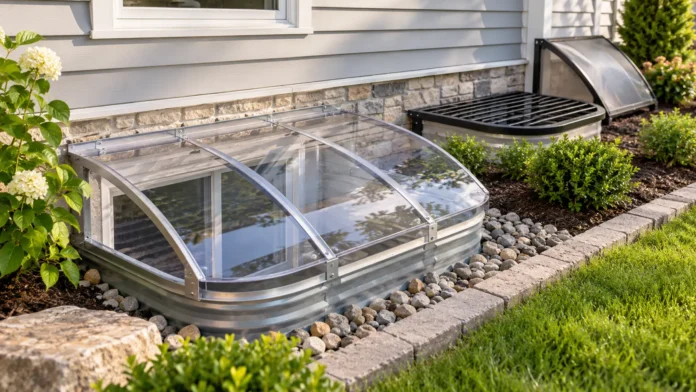
Window well covers are an important home improvement feature that helps protect basement windows from rain, snow, fallen leaves, debris, and unwanted outdoor elements. These protective covers fit over window wells, which are recessed spaces surrounding basement windows below ground level. Choosing the right window well cover can improve safety, reduce maintenance, and help keep basement areas cleaner and more comfortable.
Window well covers are available in various materials, designs, sizes, and price ranges to suit different residential needs. From affordable plastic covers to durable metal grates and custom polycarbonate designs, each option offers different advantages. This guide explains window well cover types, standard dimensions, installation costs, safety considerations, and practical tips for selecting the most suitable cover for your home.
What Are Window Well Covers and How Do They Work?
Window well covers are protective structures installed over the openings of basement window wells. They help prevent leaves, branches, animals, and other outdoor debris from collecting inside the recessed areas. Depending on their design, covers can also reduce direct rainwater entry while allowing natural light to reach basement windows.
Most window well covers rest on or attach to the surrounding well structure using compatible mounting components. They may feature transparent panels, metal grates, curved surfaces, or hinged sections. The appropriate design depends on the window well’s dimensions, its location, and whether the basement window serves as an emergency escape opening.
A properly fitted cover should remain stable during ordinary weather conditions without interfering with necessary window operation. Covers installed above emergency escape windows must allow occupants to exit quickly without special tools or keys. Understanding these requirements helps homeowners select protective products that provide practical benefits without creating dangerous obstructions.
Benefits of Installing Window Well Covers
One major advantage of window well covers is their ability to reduce the accumulation of leaves, dirt, and other debris. Open window wells can collect materials that block drainage openings or create unnecessary maintenance problems. A suitable cover helps keep the area cleaner and reduces the frequency of debris removal.
Window well covers can also provide additional protection against accidental falls, especially when installed beside walkways or frequently used outdoor spaces. However, not every product is designed to support a person’s weight. Homeowners should check the manufacturer’s load rating rather than assuming that any plastic panel or metal grille provides adequate fall protection.
Transparent window well covers offer another benefit by allowing daylight into basement rooms. Certain enclosed designs also help reduce the amount of precipitation entering the well, although they do not replace proper drainage. Combining suitable covers with maintained drainage systems can improve overall basement protection and reduce avoidable moisture concerns.
Different Types of Window Well Covers Explained
Window well covers are available in several styles because residential window wells differ in shape, depth, and location. Common designs include flat covers, dome-shaped covers, sloped covers, metal grates, and custom-fitted panels. Each type provides different levels of debris protection, weather resistance, daylight transmission, and structural strength.
Flat window well covers are often suitable for openings with relatively even surrounding surfaces. Dome-shaped designs provide additional vertical clearance and may help accommodate windows that extend above the well rim. Sloped covers are designed to encourage rainwater and some accumulated debris to move away from the protected opening.
Metal grates offer a different approach because their open construction allows greater airflow and water passage. Transparent polycarbonate covers are popular when daylight and precipitation protection are priorities. Understanding how these designs function helps homeowners match the cover to their existing window well and intended protective purpose.
Plastic Window Well Covers: Affordable and Lightweight
Plastic window well covers are among the most affordable options available for homeowners seeking basic protection. They are commonly manufactured from lightweight molded materials and sold in different shapes and dimensions. These covers can help reduce the amount of leaves, dirt, and precipitation entering a basement window well.
One advantage of plastic covers is their relatively low weight, which can simplify handling and installation. Many products are available in standard sizes designed for common residential window wells. However, lightweight construction may also limit durability, especially when exposed to strong sunlight, heavy snow, or repeated physical stress.
Basic plastic window well covers may cost approximately $30 to $150 for materials alone, depending on size and construction. Premium or professionally installed options can cost more. Homeowners should carefully review load ratings, ultraviolet resistance, and emergency escape compatibility before selecting a low-cost plastic cover.
Polycarbonate Window Well Covers: Strong and Transparent
Polycarbonate window well covers are popular because they combine transparency with greater impact resistance than many basic plastic alternatives. These covers allow natural light to enter basement windows while creating a protective barrier against falling debris. Certain designs also offer additional resistance to weather exposure and accidental impacts.
Many polycarbonate covers feature curved or sloped surfaces that help direct rainwater away from the window well. Some products use reinforced frames or other structural supports to improve load-bearing performance. However, actual strength depends on thickness, construction, mounting components, and the manufacturer’s published specifications.
Polycarbonate window well covers commonly cost around $150 to $350 for standard products and straightforward installations, although larger or specialized systems may cost considerably more. They can provide a useful balance between appearance, durability, and protection. Homeowners should choose products specifically rated for their intended loads and local environmental conditions.
Metal Window Well Covers: Durable and Protective
Metal window well covers are typically constructed from steel, aluminum, or other weather-resistant materials. They often feature grates, mesh panels, or reinforced frames that create a strong protective surface. These products can be particularly useful for window wells located near walkways, patios, and other frequently used outdoor areas.
Metal grates allow air and water to pass through their openings, making them different from solid transparent covers. While this provides ventilation, it also means that rainwater, smaller debris, and snow can enter the well. Some manufacturers combine metal frames with transparent panels to provide additional protection against precipitation.
Metal window well covers generally cost around $250 to $700 installed for common designs, with specialized products costing more. Material thickness, corrosion-resistant finishes, and structural ratings influence the final price. Homeowners should also confirm that the cover can be opened or removed appropriately when installed above an emergency escape window.
Standard Window Well Cover Sizes and Dimensions
Window well covers are manufactured in different dimensions to accommodate common residential basement window wells. Some frequently encountered cover sizes are approximately 24 by 36 inches, 30 by 36 inches, and 36 by 48 inches. However, these examples are not universal standards, and actual dimensions vary according to the manufacturer and window well design.
Window well openings may be rectangular, semicircular, rounded, or irregularly shaped. The cover must match the overall opening rather than simply correspond to the basement window’s glass dimensions. Measuring the well’s width, projection from the foundation, and surrounding mounting surfaces provides useful information when selecting a compatible product.
Larger basement escape wells often require wider covers with special opening mechanisms. The required clearance also depends on how the underlying window operates and whether it opens inward or outward. Homeowners should avoid relying entirely on advertised dimensions and instead compare detailed product measurements with the actual opening.
How to Measure for a Window Well Cover
Accurate measurements are essential for choosing a window well cover that fits properly and provides reliable protection. Homeowners should identify the well’s overall shape and record its maximum width and projection from the foundation wall. Measuring the exterior opening is generally more useful than measuring only the visible basement window.
Curved wells may require additional measurements because their dimensions change across the opening. The shape of the surrounding wall and the position of any raised well edges can also influence product compatibility. Manufacturers may provide specific measurement diagrams to help homeowners identify whether their covers suit the existing structure.
For irregular or unusually large window wells, professional measurement may be the most reliable approach. Contractors can evaluate mounting conditions, drainage concerns, and emergency escape requirements before recommending a suitable design. Incorrect measurements may result in gaps, unstable installation, or interference with window operation, potentially requiring replacement or modification.
How Much Do Window Well Covers Cost in 2026?
Window well cover installation costs vary considerably across the United States depending on materials, dimensions, and project complexity. In 2026, many professionally installed projects fall between approximately $360 and $1,360, with an average near $840 in published national estimates. Simple standard covers may cost significantly less than customized or reinforced systems.
Basic plastic covers are generally the least expensive, while durable polycarbonate and metal products command higher prices. Premium custom-fabricated covers can cost $1,000 or more when specialized construction is required. These figures represent broad market estimates rather than guaranteed prices for every property or installation.
Homeowners should distinguish between the cost of the cover itself and the complete installation price. Professional labor, mounting hardware, adjustments, and delivery expenses may increase the final total. Obtaining detailed local estimates is the most reliable way to establish a realistic budget for a specific basement window well.
Factors That Affect Window Well Cover Prices
Material selection is one of the largest factors influencing the cost of window well covers. Lightweight plastic products usually cost less than reinforced polycarbonate or steel systems. Protective coatings, structural ratings, and specialized opening mechanisms can also increase the price of a particular design.
Size and shape also matter because larger covers require additional material and may need reinforced construction. Standard rectangular or semicircular models are often less expensive than unusual shapes requiring custom fabrication. Window wells located against uneven walls or surrounded by complicated landscaping may create additional installation challenges.
Local labor rates and project accessibility influence total costs when professional installation is necessary. A straightforward replacement on an existing compatible well may be relatively inexpensive. However, damaged well walls, drainage problems, or structural repairs can increase the overall project budget beyond the price of the cover itself.
Custom Window Well Covers for Unusual Shapes
Custom window well covers are designed for openings that cannot accommodate standard manufactured products. They may be necessary for oversized basement windows, irregular well shapes, or architectural features that complicate installation. Custom fabrication allows manufacturers to create covers that better match specific dimensions and mounting requirements.
These products can incorporate materials such as polycarbonate, aluminum, and reinforced steel, depending on the required design. Homeowners may also select specialized finishes or suitable hinged opening mechanisms. The final construction should balance durability, drainage considerations, daylight requirements, and emergency escape compatibility where applicable.
Custom covers usually cost more because they require individual measurements, specialized materials, and additional fabrication work. Complex designs can reach $1,000 to $2,000 or more, depending on specifications. Before ordering, homeowners should confirm the manufacturer’s measurement requirements, warranty conditions, structural ratings, and installation arrangements.
Window Well Cover Installation: What to Expect
Professional window well cover installation generally begins with inspecting the existing well and confirming its measurements. The installer evaluates the surrounding surfaces, mounting locations, and intended operation of the selected product. Any existing damage or drainage problems should be identified before the cover is fitted.
Once a suitable cover is selected, installation involves positioning and securing it according to the manufacturer’s approved method. The exact process differs between lightweight covers, reinforced grates, and hinged systems. Products designed for emergency escape openings require particular attention to their release mechanisms and available exit clearance.
After installation, the contractor should verify that the cover operates properly and remains stable under intended conditions. Homeowners should understand how the product opens and what maintenance it requires. Covers must not obstruct emergency exits, and any unresolved safety concerns should be addressed before the installation is considered complete.
Egress Window Well Covers and Safety Requirements
Egress window well covers require special consideration because they may be installed above windows intended for emergency escape and rescue. Building codes generally require these openings to remain usable without a key, tool, or special knowledge. A cover that prevents someone from exiting quickly can create a serious safety hazard.
Approved egress covers must be releasable or removable from inside while maintaining the required clear opening. The exact requirements depend on the locally adopted building code and the configuration of the window well. Homeowners should not install permanent locking devices or incompatible covers that could prevent an occupant from leaving during an emergency.
A properly designed egress cover balances protection against falls and debris with safe emergency operation. Local building departments and qualified contractors can help verify whether a proposed product meets applicable regulations. Maintaining the release mechanism and keeping the escape route clear are essential responsibilities after the cover is installed.
Window Well Cover Maintenance and Cleaning
Regular maintenance helps window well covers remain functional and prevents debris from accumulating around drainage areas. Leaves, dirt, and other materials should be removed from accessible surfaces when conditions are safe. Keeping the surrounding area clean also helps homeowners identify visible damage before it creates more serious problems.
Transparent plastic and polycarbonate covers may require cleaning to maintain light transmission and appearance. Suitable mild cleaning products and soft materials can help reduce unnecessary surface damage. Metal covers should be inspected for corrosion, damaged protective finishes, and loose components according to the manufacturer’s maintenance recommendations.
Homeowners should also ensure that the window well’s drainage system remains functional because a cover cannot guarantee complete waterproofing. Standing water, repeated flooding, or persistent moisture requires investigation beyond simply replacing the cover. When access or inspection involves deep wells or elevated surfaces, qualified professionals should handle potentially hazardous work.
How to Choose the Best Window Well Cover
Choosing the right window well cover begins with determining the main purpose of the installation. Some homeowners prioritize keeping leaves and rainwater out, while others need additional protection against accidental falls. Basement daylight, local weather conditions, and emergency escape requirements should also influence the decision.
Material quality and product specifications are important when comparing different covers. Homeowners should evaluate structural ratings, ultraviolet resistance, corrosion protection, and manufacturer warranties. A low-cost product may be appropriate for some locations, while a reinforced cover may provide better value where demanding environmental conditions require additional durability.
The final choice should match the window well’s dimensions and allow the underlying window to operate as intended. Reviewing multiple products and consulting qualified installers can help homeowners avoid compatibility problems. Selecting a suitable cover based on actual property conditions is generally more reliable than choosing solely by appearance or price.
Conclusion
Window well covers provide practical protection for basement window openings by reducing debris accumulation, limiting some weather exposure, and improving safety when appropriately designed. Plastic, polycarbonate, and metal options offer different advantages in terms of price, durability, appearance, and strength. Understanding these differences helps homeowners choose products suited to their specific needs.
Costs depend on materials, dimensions, installation requirements, and whether custom fabrication is necessary. Standard covers are generally more affordable, while reinforced and custom-designed products involve greater expense. Accurate measurements, appropriate installation, and attention to drainage are important for achieving reliable performance without introducing unnecessary complications.
The best window well cover combines suitable protection with proper fit and safe operation. Emergency escape openings require particular care because covers must not prevent occupants from exiting quickly. With thoughtful selection, professional guidance when necessary, and regular maintenance, window well covers can become valuable additions to a home’s exterior protection system.
Frequently Asked Questions (FAQs)
1. How Much Does a Window Well Cover Cost?
Basic window well covers may cost as little as $30 for materials, while many professionally installed projects range from approximately $360 to $1,360. Custom and reinforced designs can cost considerably more.
2. What Is the Best Material for Window Well Covers?
Polycarbonate is popular for its transparency and impact resistance, while metal grates provide durable protection and airflow. The best material depends on weather conditions, load requirements, budget, and emergency escape needs.
3. What Sizes Do Window Well Covers Come In?
Common cover dimensions include approximately 24 by 36 inches, 30 by 36 inches, and 36 by 48 inches. Sizes vary by manufacturer, and unusual window wells may require custom measurements.
4. Can Window Well Covers Prevent Basement Flooding?
Window well covers can reduce direct precipitation and debris entering the well, but they cannot guarantee flood prevention. Proper drainage, grading, and foundation waterproofing remain important for controlling basement moisture.
5. Are Window Well Covers Required for Egress Windows?
Window well covers are not universally required for egress windows. However, when installed, they must meet applicable building codes and allow emergency escape without tools, keys, or special knowledge.